
Problem
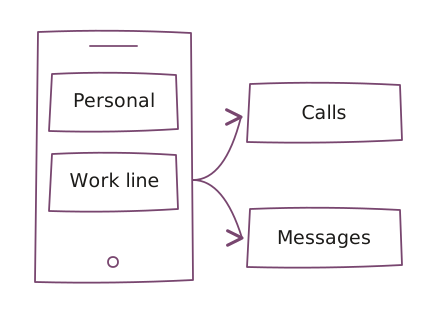
People using one phone for personal and business conversations need a way to keep those conversations separate. Carrying another device is not always a useful answer.
For a product team, the work extends beyond placing a call. Number selection, messages, voicemail, and the controls around incoming calls need to form a coherent user journey.
What we built
- Enabled users to select a separate number without another SIM.
- Supported calling and texting through that number.
- Provided voicemail with a custom greeting.
- Supported caller identification and call blocking.
- Delivered mobile and web application experiences.
How it runs
- Choose a separate number in the product.
- Use that number for calls and text messages.
- Identify incoming callers within the calling experience.
- Block unwanted calls when needed.
- Manage voicemail and the greeting callers hear.
Who uses it
Individual users manage a separate communication line. Product owners define the service experience. Engineering and operations teams maintain the application and its dependencies.
Technology and integrations
Choose the mobile, web, and communication services around the devices and calling features you need. Explore our development technologies to discuss the application architecture.
A product build, with provider prerequisites
UCS builds calling and messaging applications for product teams. If you want to purchase a second number for personal or business use, choose a phone-service provider; this is not a phone subscription offer.
For an application build, first identify the provider services available for the intended markets, numbers, calling, and messaging features. Confirm permitted account and API access, operating costs, and provider terms before committing to the feature set. A screen for choosing a number cannot make an unavailable number or unsupported service available.
Your product owner decides the service experience and support boundary. UCS and your technical owner scope provider integration and acceptance examples, including unavailable numbers, failed calls or messages, and interrupted connectivity. Assign who handles provider incidents and customer support. If your need is simply to configure an existing calling service, assess that before building a product.
Engagement fit
Product engineering fits a defined application or integration outcome. Agree on the first useful release, acceptance criteria, and who will operate it.
Scope this work with product engineeringWhat to agree before building
- Agree on target devices, number availability, provider dependencies, and markets served.
- Define call and message behavior, failure handling, account access, and customer support responsibilities.
- Review provider terms, operating costs, and any required calling-service obligations before committing to a release.
Questions before we start
Are you offering a phone-number subscription here?
UCS builds calling and messaging applications for product teams; UCS is not offering a phone-number subscription on this page. To buy a second number, use a phone-service provider. A custom product build needs provider access, a defined market, and an operating owner.
Does this need another SIM?
The delivered calling application let users select and use a separate number without another SIM. A new product still needs validated connectivity, number availability, and provider requirements for its intended markets.
Did the work include web as well as mobile?
UCS built mobile and web applications for the calling and messaging product. Device and feature coverage for another implementation must be scoped separately, along with provider integration and release checks.
Can every country and calling feature be included?
Calling and messaging coverage depends on the chosen providers and operating scope. Validate number availability, messaging and calling features, permitted integration access, provider terms, and costs before committing to a market or release.
Related
- Leasing and refinancing workflows for lenders and operators
- Vision inspection on a manufacturing line
Read about our calling and messaging project.
Discuss your workflow
Bring the intended markets, devices, calling and messaging features, proposed providers, and known account or integration constraints. Include the product decision owner and the person responsible for provider relationships and customer support. Use synthetic call flows; do not send credentials, call recordings, phone-number lists, or confidential message histories.