
Problem
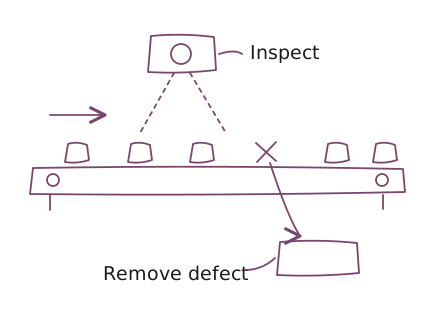
A manufacturing team needs an inspection result while the product is still in a position where the line can act on it. An image assessment alone does not remove a defective item.
The engineering problem spans the camera view, software analysis, and physical line response. The operating conditions and acceptable errors need to be understood together.
What we built
- Connected camera feeds to the inspection system.
- Analyzed product images for defects.
- Coordinated removal of defective products on the line.
- Integrated the inspection hardware and coordinating software.
How it runs
- Present products to the inspection camera as they move along the line.
- Pass the camera feed into image analysis.
- Identify a defective product within the inspection flow.
- Coordinate the removal action with the line.
- Remove the affected product from the production flow.
Who uses it
Quality teams define the defect criteria. Line operators run the process. Engineering and maintenance teams manage the equipment and integration boundary.
Technology and integrations
Choose the hardware and software around the camera, inspection conditions, and production-line interfaces. Explore our development technologies when planning the application and integrations.
Choose inspection alone or action on the line
Choose the integrated scope when the inspection result must trigger a physical action while the product is in position. This needs equipment access, timing information, a line integration owner, and quality criteria the team can test.
If the need is to review stored images or flag possible defects for a person, a bounded AI inspection workflow may be sufficient. Do not add line control where a review step meets the need. If line interfaces or authority over physical actions are unavailable, resolve those gaps before planning automatic removal.
Agree on a sample acceptance exercise
Before a trial, the quality owner should identify representative acceptable products, defect categories, and uncertain examples. Agree on the operating conditions, including lighting, presentation, and line speed, and how missed defects and incorrect removals will be assessed. Keep examples for evaluation separate from examples used to adjust the inspection.
For an integrated trial, assess the detection and the correctly timed line action together. A useful image result does not establish that the intended item was removed. Operations and engineering must approve test access, safe fallback behavior, and who can stop or resume the trial. If samples or operating conditions are unrepresentative, narrow the conclusion rather than claim production acceptance.
Engagement fit
Product engineering fits a defined application or integration outcome. Agree on the first useful release, acceptance criteria, and who will operate it.
Scope this work with product engineeringWhat to agree before building
- Agree on products, defect examples, lighting, line speed, and equipment access.
- Define acceptance criteria for missed defects and incorrect removals using representative samples.
- Assign responsibility for line safety, stop conditions, maintenance, and changes to the inspection setup.
Questions before we start
Can the system work with our existing line?
Vision inspection compatibility with an existing line requires an assessment of camera placement, timing, equipment interfaces, and the removal mechanism. Confirm equipment access and a line integration owner before deciding what can be reused.
What defect accuracy can you promise?
Vision inspection accuracy depends on products, defect categories, and operating conditions. Representative samples, agreed test conditions, and criteria for missed defects and incorrect removals are needed before committing to an acceptance threshold. Selected images alone do not establish production performance.
Is this only an image-analysis project?
The delivered UCS vision inspection work connected camera inspection to product removal, including hardware, software, and production-line integration. An inspection-only workflow can be scoped separately when human review is sufficient and automatic line action is unnecessary.
What happens when inspection cannot make a reliable decision?
An uncertain vision inspection result needs a response agreed by quality and operations: request review, remove an item, or stop the line as appropriate to the system. Assign authority for those actions and test the fallback before relying on automatic operation.
Related
- Leasing and refinancing workflows for lenders and operators
- A second calling line on the phone you already use
Read about our production-line inspection project.
Discuss your workflow
Bring defect categories, a description of representative samples, camera and line interfaces, operating conditions, and the intended response to an uncertain result. Include the quality decision owner and the person authorized to approve equipment access and line actions. Share only permitted, sanitized examples; do not send credentials, confidential production footage, or proprietary product datasets.