
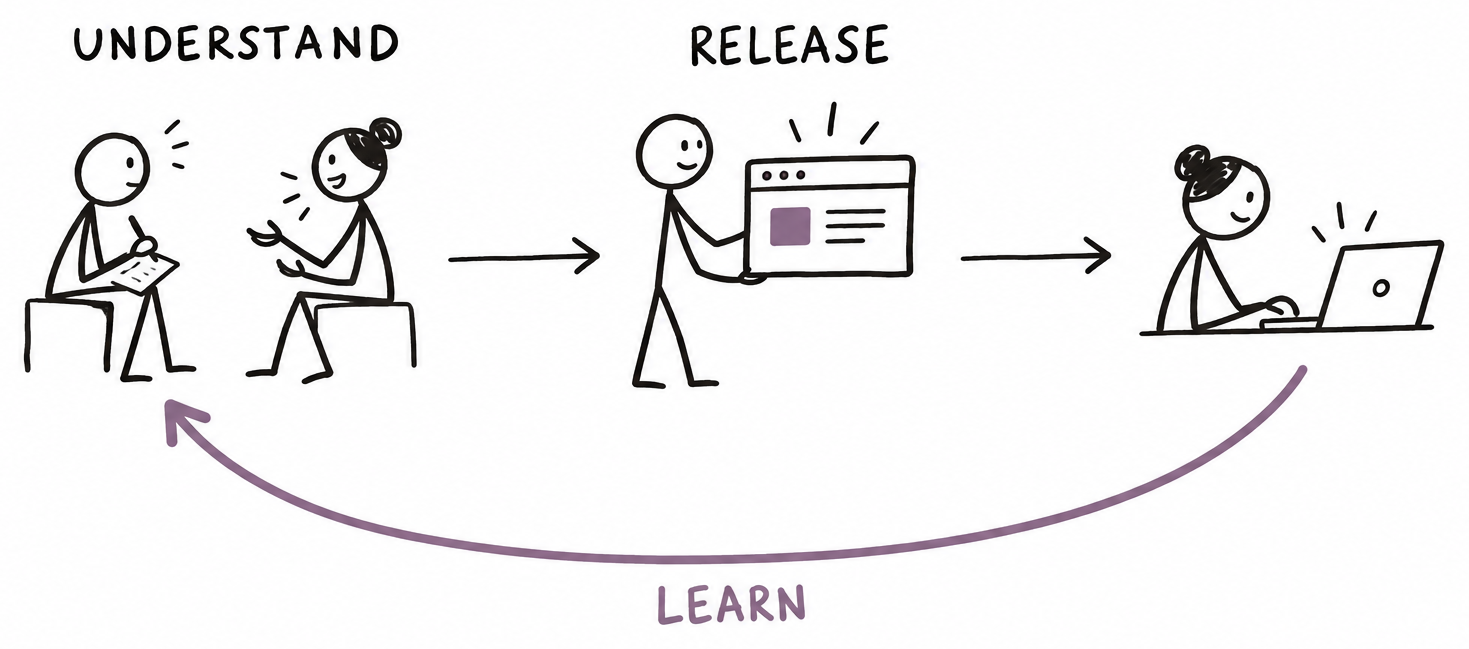
Understand the workflow, ship a useful slice, observe use, and improve the product. Learning returns to the next decision.
Product engineering services connect product decisions, design, software delivery, and ongoing operation across a product’s lifecycle. UCS provides digital product engineering for founders and teams building a first release, scaling an existing platform, or modernizing working software. Use it when the product outcome needs coordinated responsibility beyond a list of development tasks.
Build: validate the core workflow
Identify the essential features and the assumptions the first release must test. Connect discovery to a technology choice, a usable prototype, and a release to real users. Gather feedback on what people can complete, then prioritize improvements before expanding the feature set.
Scale: connect architecture, integrations, and releases
Review the application stack, API dependencies, and delivery pipeline together. Engineering can span web and mobile interfaces, backend services, and cloud infrastructure. Strengthen performance, security, and release automation around the actual workload so new features do not outpace the ability to operate them.
Evolve: modernize in stages
Begin with a product and technology audit, then define the target architecture and migration sequence. Refactoring, API boundaries, cloud changes, and data migration can be separate increments. Validate the behavior users depend on at each step, with migration checks and a rollback plan before switching traffic or data. Before the first increment, choose between refactoring, rewriting, and wrapping for each part of the system.
Keep design and engineering in the same scope
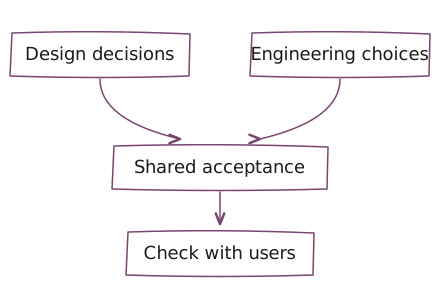
Interface design, implementation, integration, testing, and post-launch improvement need a shared product goal.
Review usability alongside technical behavior. Agree on acceptance criteria and the operating responsibilities that remain after release, rather than ending the conversation at feature completion.
For a new user workflow, that means agreeing on what a person must be able to complete, how the interface handles errors, which systems it depends on, and how the release will be checked. Design and engineering decisions can then be reviewed against the same outcome. Name the person who resolves scope tradeoffs when those needs compete.
Product engineering vs. software development
Software development implements and changes software. Product engineering connects those changes to user needs, design decisions, release quality, and ongoing operation. A bounded development project may be sufficient when your team already owns those surrounding responsibilities.
Choose a narrower scope when it covers the gap:
- Design: discovery or interface work may be enough if your engineers can implement and operate the result.
- Implementation capacity: additional engineers may be enough if your team owns priorities, architecture, and release acceptance.
- Leadership: fractional direction may be enough if the team can deliver once decisions are clear. Compare a fractional CTO with an agency to separate decision ownership from build capacity.
Use a broader product engineering scope when decisions across those boundaries need to be resolved together. Define which responsibilities remain with your team, including who accepts the release and owns it afterward.
Choose who owns the work
Start with the responsibility that is missing, then choose the engagement:
- Implementation depends on close access to users and systems: use FDE. Name the product owner, access approver, and first workflow to accept.
- The team can deliver but decisions are stalled: use Fractional X. Agree on the leadership remit and decision rights; implementation capacity is separate.
- A continuing roadmap needs stable capacity: use a dedicated team. Confirm management capacity, review cadence, and any intended transfer terms.
- A working product needs ongoing care: use managed support. Agree on covered systems, escalation, and coverage, and compare managed support with a project warranty when the product is near or just after launch. A major build or migration needs a delivery scope.
Product engineering describes the work across design, implementation, and operation; these engagements define how people carry it. A small, well-defined implementation may be sufficient when your team already owns product decisions and release care. Add AI and agents only for a workflow with usable inputs and a way to evaluate errors.
Agree on a first release you can judge
Your product owner identifies a user task, expected behavior, and unacceptable failures. UCS and your technical owner review interfaces, data access, dependencies, and migration constraints. Agree on acceptance examples before implementation, including error handling and the behavior existing users must retain. Name who accepts the release and who responds if it fails after launch.
The business applications project illustrates delivery across project, client, and signing workflows. Its delivered scope is a reference for discussion, not a package of integrations or promised results for another product.
Questions before we start
How is product engineering different from software development?
Product engineering connects implementation to user needs, design, release acceptance, and ongoing operation. A narrower software development scope may be enough when your team already owns those surrounding decisions and responsibilities.
How do Build, Scale, and Evolve apply?
Build, Scale, and Evolve describe product needs: validate a useful first release, strengthen delivery as demand grows, and maintain or modernize working software. Each stage needs acceptance checks and an operating owner; modernization must preserve required behavior and address migration and rollback.
Which engagement fits product engineering?
Product engineering can use FDE for embedded implementation, fractional leadership for decision ownership, a dedicated team for a continuing roadmap, or managed support for agreed care of a working product. Choose by the missing responsibility. Leadership and support agreements do not automatically include a new product build.
How should we choose a digital product engineering partner?
A digital product engineering partner should explain relevant delivered work, ownership of product decisions, release validation, operations, and handover. Confirm who supplies access and acceptance examples and who resolves scope tradeoffs; a technology list alone cannot establish delivery fit. If the MVP was built mostly with AI coding tools, review it before you modernize.
Can we start with an MVP and modernize later?
An MVP can start with a core workflow and use feedback to guide expansion. Later modernization can proceed through bounded interfaces or workflows, subject to the existing system. Check required behavior, data migration, and rollback before each change.
Bring the first product decision
Bring the user workflow, current product stage, known dependencies, and a few sanitized acceptance examples. Identify who decides scope, who approves access, and who would operate the release. Include timing and budget constraints if known; do not send credentials, customer records, or confidential code dumps.