
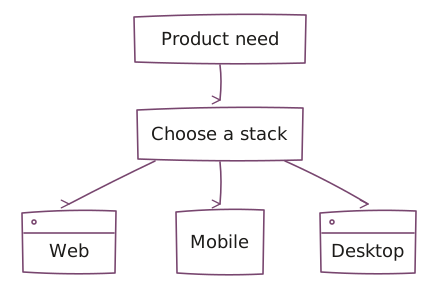
Choose a technology for your application
Compare the options below against your existing systems, device requirements, and maintenance needs.
.NET

APIs and application services that connect business workflows.
Explore .NET developmentPython

Application services, data preparation, and repeatable jobs.
Explore Python developmentMERN


Web interfaces, APIs, and application data in one delivery scope.
Explore MERN developmentSwift / iOS

Native mobile interfaces and device-specific behavior.
Explore Swift / iOS developmentLaravel / PHP


Web applications, APIs, and background jobs around business workflows.
Explore Laravel / PHP developmentFlutter

Shared mobile applications with platform-specific release checks.
Explore Flutter developmentReact Native
Shared mobile interfaces with native platform integration.
Explore React Native developmentElectronJS

Desktop applications built with web technologies.
Explore ElectronJS developmentChoose the smallest stack that covers the workflow
Begin with where people do the work, then test the choice against existing systems and the people who will maintain it:
- Business services and web workflows: compare .NET for application services and business integrations, MERN for a browser interface and APIs, and Laravel / PHP for web workflows and background jobs. Existing code, record relationships, and maintenance skills can be more decisive than starting a new stack.
- Data preparation or repeatable jobs: consider Python. Define inputs, failure handling, and an operating owner. A built-in export or existing scheduled task may already meet the need.
- Mobile delivery: use Swift / iOS when native iOS behavior is central. Compare Flutter and React Native when shared mobile code is useful, with device integrations and release checks reviewed separately.
- Desktop delivery: consider ElectronJS when local files, windows, or operating-system integration are required. A browser application may be enough when those capabilities are unnecessary.
Do not replace a working stack just to match this list. A configuration change, existing platform workflow, or narrower integration may solve the problem with less ongoing maintenance. Before choosing, name the technical decision owner, supported environments, required interfaces, and the checks that would demonstrate an acceptable release.
Connect with your existing platforms
Explore our application delivery across Microsoft, Apple, and Google. We plan integrations around the systems your team already uses.
Explore software we have built, from approval workflows to user reporting.
Start with the application
Use product engineering to connect product decisions, implementation, and release. Choose forward-deployed engineering when delivery needs an embedded team close to users and systems.
Questions before we start
How should we choose a development stack?
A development stack should follow the application workflow, existing systems, supported devices, and maintenance skills. Compare required interfaces and release checks with the technical decision owner before choosing a language or framework. A working stack does not need replacement simply because another option is available.
When is custom application development unnecessary?
Custom application development may be unnecessary when an existing configuration, export, platform workflow, or bounded integration covers the need. Confirm access, exceptions, and maintenance responsibility before adding a separate application to operate.
How should we choose native or shared mobile code?
Native iOS development fits workflows where iOS behavior and device integration drive the application. Flutter and React Native can share mobile code, but each supported platform still needs integration review, device testing, and release ownership. Choose around those requirements and the maintaining team.
Does choosing a technology include ongoing support?
A technology choice does not include ongoing support by itself. Agree on hosting, dependency updates, monitoring, release acceptance, and who responds to failures. Managed support can cover separately agreed responsibilities after launch.
Bring the workflow and maintenance constraints
Bring one workflow, current stack and dependencies, target devices, and known maintenance constraints. Include the technical decision owner and the person who will operate the application. Use sanitized diagrams or examples; do not send credentials, confidential source exports, or customer datasets.