
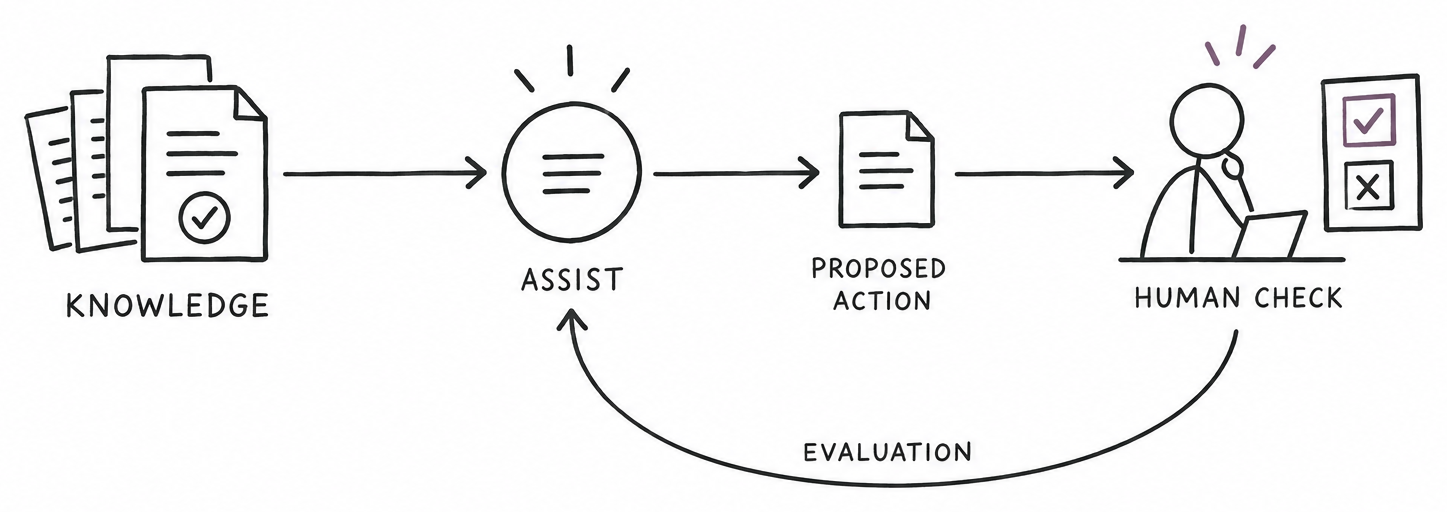
Approved knowledge supports an AI workflow. Evaluation and human approval keep consequential actions within agreed boundaries.
AI product engineering connects models, retrieval, and agentic systems to defined workflows, with reliability assessed against agreed evaluation criteria. UCS provides it for product teams and operators with a defined task and usable data. Use it when AI must integrate with existing software, respect permissions, and meet measurable quality, latency, and cost requirements in production.
What this looks like
- Vision inspection on a production line: camera hardware, inspection software, and line integration connect image capture to defect checks. See the inspection project.
- Self-hosted retrieval over recordings: speech-to-text makes recorded classes searchable, with questions handled through the education platform’s own inference endpoints. See the recorded-class project.
- Assistants over approved knowledge and systems: connect retrieval to permitted sources and define which actions require human approval. Scope these around a specific workflow and an operating owner.
Models and providers we use
UCS integrates OpenAI, Anthropic (Claude), and Google AI APIs in delivery. We use xAI (Grok) selectively, where it fits the workflow.
Model selection is one part of the work. We connect permitted data sources, evaluate results against representative tasks, and define permissions, monitoring, failure handling, and human oversight. Choose the provider around the task, data requirements, response quality, latency, and operating cost. Recheck behavior when the model or workflow changes.
Start with workflow fit and data readiness
Identify the task, the people affected, and the consequence of a wrong result.
Review the available data and integration needs before choosing a model. Useful scopes include document handling, workflow automation, and predictive decision support; each needs an owner and a clear way to judge its behavior.
AI fits tasks that need interpretation of language, images, or varied inputs and have examples a reviewer can judge. If stable rules, a database query, or a form can meet the need, ordinary software may be simpler to test and operate. Do not expand automation when nobody can assess a wrong answer or take over a failed task.
Check whether the available material is current, usable for this purpose, and representative of the work. Identify missing examples, conflicting documents, and access restrictions early. If the data cannot support a reliable test, narrow the workflow or resolve that gap before expanding automation.
Connect retrieval and agents to existing systems
Retrieval can bring approved documents into an answer; an agent can use tools to take steps in a workflow. Engineering includes data connections, retrieval pipelines, application integration, and model lifecycle management. Define which sources and actions are allowed before extending access to more systems.
Set permissions at the system boundary
Agree on which users may retrieve each source and which tools may read or change records. Enforce those permissions in the application and connected systems; a prompt telling a model to keep information private is not an access control. Start with the least access the workflow needs, and test attempts to retrieve restricted material or trigger an unauthorized action.
Carry the work through deployment and improvement
Discovery, data preparation, deployment, integration, and ongoing improvement are parts of the same delivery scope. Decide who maintains the system and reviews feedback after launch. Changes to models, source content, or workflows need validation before they become the production default.
Production AI vs. a demo or scripted workflow
A demo shows that an idea can work on selected inputs. Production AI must work within actual permissions, failure conditions, and operating costs. A scripted workflow may be the better choice when rules are stable and deterministic behavior is sufficient. A conversational interface alone does not make a system agentic.
A proof of concept is useful when the immediate question is feasibility. A conversational interface can be appropriate when people need to ask questions or review results. Choose the smallest approach that meets the need, then define its quality checks and operating owner before relying on it.
How UCS engages: evaluate before expanding
Start with one bounded workflow and representative evaluation tasks.
- Define the task. Your process owner identifies intended users, permitted data, unacceptable errors, and the person authorized to approve consequential actions. UCS helps turn these into an implementation and evaluation scope.
- Build a bounded trial. UCS connects the approved sources and tools. Your subject expert supplies representative examples and judges whether answers and proposed actions are useful.
- Make a release decision. Agree on acceptance criteria before testing. Review wrong answers, missed evidence, unauthorized requests, tool failures, latency, and cost. A weak result is a reason to narrow the scope or keep the task manual.
- Assign operating responsibility. Name who investigates failures, changes permissions, reviews feedback, and validates updates. Agree on response coverage and a way to pause automation.
Check answer quality, source grounding, tool selection, and failure handling alongside latency and cost. Define approval points for consequential actions, monitor production behavior, and retain a fallback when the system cannot complete the task reliably.
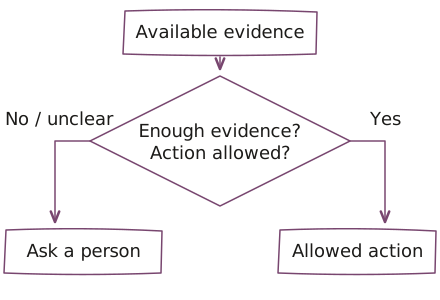
Include cases where the correct behavior is to stop or ask for help:
- Missing or conflicting evidence: surface the gap rather than produce an unsupported answer.
- Insufficient permission: leave the restricted data or action inaccessible.
- A failed tool call: make the failure visible and avoid repeating an action that may already have completed.
- A consequential action: give the reviewer enough context to approve, reject, or take over.
Agree on who reviews failures after launch and when a model, document, or workflow change requires another evaluation. Ongoing review and response coverage belong in the operating scope.
Work with FDE when integration needs close access to users and systems, or an AI lead through Fractional X when decision ownership is the gap. Use product engineering for the surrounding application and managed support for agreed care after launch. To plan that care, see what AI operations add to managed support and how managed support differs from a project warranty.
Agree on data, ownership, and operating limits
Before implementation, record who may use source data, prompts, evaluation examples, logs, and generated outputs, and for what purpose. Agree on retention, deletion, provider access, and any residency requirements before selecting hosting or sending data to a model service. Availability of an API does not establish permission to share data with it.
Separate ownership of commissioned application code and prompts from licenses for third-party models, libraries, and services. If model customization is needed, agree separately on the rights to training material and resulting artifacts. No engagement should assume ownership of a provider’s underlying model. See our delivery practices for the decisions to settle before access is granted.
Questions before we start
What makes an AI system production-ready?
Production readiness for an AI system requires representative evaluations, controlled data access, monitoring, fallback behavior, and an operational owner. A successful demo alone does not establish readiness.
What is an agentic system?
An agentic system uses a model to choose steps or tools within a workflow. Production use requires bounded permissions, visible actions, and human approval for consequential actions.
Why do AI proofs of concept fail to reach production?
AI proofs of concept can stall because of unrepresentative test data, unclear ownership, weak integration, uncontrolled costs, and undetected bad outputs. Read why AI proofs of concept stall before expanding the workflow.
What should we ask an AI implementation partner?
Ask an AI implementation partner how it evaluates quality, controls data and tool access, detects failures, and decides when humans intervene. Confirm maintenance ownership and review quality, latency, and cost together. Before you sign, read how to contract and accept AI work.
What happens when the AI cannot complete a task reliably?
An AI workflow needs a defined fallback for each relevant failure: ask for clarification, stop an action, or pass the task to a person. Reviewers need the evidence, attempted actions, and failure context. Agree on who investigates recurring failures and validates changes after launch; ongoing response coverage must be scoped.
When is traditional software enough?
Traditional software is often enough when stable rules, forms, or database queries can complete the task. Consider AI when varied inputs need interpretation and a reviewer can evaluate the result. AI is a poor fit when errors cannot be assessed or a failed task has no safe fallback.
Who owns AI prompts, data, and models?
Ownership and permitted use of AI application code, prompts, source data, evaluation material, logs, and outputs must be agreed in the engagement. Third-party models and services remain subject to their licenses and terms. Model customization needs separate agreement on training material and resulting artifacts.
Do we need an FDE for AI deployment?
FDE fits AI deployment that needs close access to users, repositories, permissions, and operational systems. Fractional AI leadership can guide decisions; managed support can cover agreed responsibilities after launch.
Bring one workflow to Contact
Bring the task, its users, a few sanitized inputs and expected results, the systems it touches, and the consequence of a wrong answer. Identify who can approve data access and who would operate the result. Share volume, response-time needs, and budget constraints if known; do not send credentials or confidential datasets in an initial inquiry.