
When staff augmentation fits
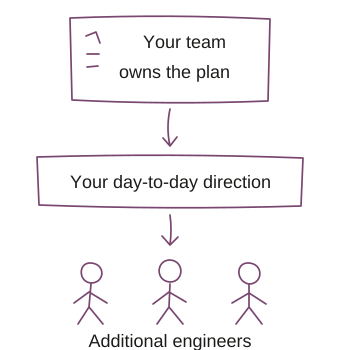
Staff augmentation fits a team that knows what it needs to build and can direct the work. You retain the implementation plan, assign priorities, manage day-to-day delivery, and decide whether the result meets your requirements. Additional engineers work within that structure.
The practical question is whether your team has enough management capacity to make those people effective. Someone needs to explain the system, make product decisions, review changes, and resolve dependencies. If those responsibilities already have owners, adding capacity can help you execute the plan without changing how delivery is organized.
Consider a backlog whose next changes are understood, with an internal engineering lead available to review them. The remaining gap may be people with the required skills. Staff augmentation can fit that situation.
Adding people does not itself resolve an unclear product goal or an access bottleneck. Before choosing this model, identify who will turn requirements into implementable work and who will accept the result. Include knowledge sharing and continuity expectations in the scope, even when your own team manages implementation.
When an FDE engagement fits
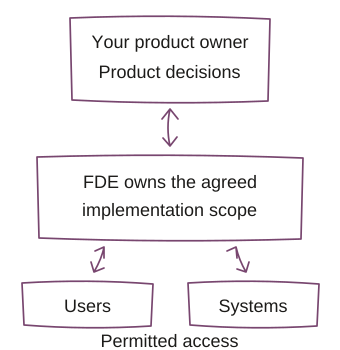
A UCS Forward Deployed Engineer engagement fits implementation that depends on close collaboration with users, operators, and the systems they use. UCS engineers own an agreed implementation scope inside your environment. Your product owner remains part of the work, making product decisions and helping unblock dependencies.
Start with the user workflow and the first useful increment. Agree on the outcome, system boundaries, required access, and evidence needed to accept it. The delivery plan should connect the product goal to architecture decisions and a prioritized roadmap, with milestones that let both teams review what comes next.
An embed is useful when the engineer needs to understand how a workflow behaves in practice. Access to the right people can reveal a missing exception or a decision that a written requirement leaves unresolved. Access to the relevant systems lets the team investigate integration behavior and test the agreed implementation in context.
That access must be permitted and available. Name the people who can approve it, answer workflow questions, and accept a release. If those people cannot participate, address the constraint before assuming an FDE will remove it. An engagement title does not grant system permissions or product authority.
The scope also includes the knowledge needed to operate what ships. Review decisions, tests, release instructions, and remaining gaps while delivery is underway. A working feature and an operating team are related outcomes, but accepting the feature does not automatically demonstrate that the team is ready to run it.
Staff augmentation
FDE engagement
Other roles compared with FDE
An advisory consultant can help decide what to do. A solutions engineer often supports evaluation or adoption. UCS FDE owns an agreed implementation scope inside your environment, including the knowledge needed to operate the result. For the deeper role choice, compare FDE, consultants, and systems integrators.
These titles are not universal boundaries. Professional services and consulting engagements may include implementation. Ask each provider to explain the actual deliverables, access requirements, and responsibilities. A comparison is useful only when both proposals describe the work at the same level of detail.
For example, advice on an integration, a demonstration that it is possible, and responsibility for shipping it into an agreed environment are different deliverables. Establish which one you need and how you will accept it. Do not infer continuing operational support from any of those deliverables unless the agreement includes it.
A decision checklist for the engagement
Use these questions with your product owner, engineering lead, and prospective delivery partner. Record the answers before choosing the engagement model. A missing owner or unavailable permission is a delivery constraint to resolve, not a detail to postpone until kickoff.
Who owns the implementation plan?
For staff augmentation, confirm that your team can break the goal into work, prioritize it, and review changes. For FDE, agree on the implementation scope and first increment with the partner. In both cases, name your product decision owner and explain how scope changes will be accepted.
Who manages day-to-day work?
Staff augmentation needs an internal manager who can direct additional people. An FDE engagement needs an agreed review cadence and clear responsibilities between your team and the partner. Establish who answers questions, resolves conflicting priorities, and decides whether a dependency changes the next increment.
What access does delivery require?
List the users, operators, environments, and integrations involved. Identify who can authorize access and the limits on data and approved tools. Give engineers only the access the work requires. If access cannot be granted, reassess what can be delivered within the permitted boundary before committing to the scope.
What evidence will you accept?
Describe what the first increment must do and how your team will review it. Identify relevant tests and integration behavior rather than relying only on a demonstration. Agree on who accepts the release and how known limitations or unresolved dependencies will be recorded. Use that evidence to review the next increment.
How will handover readiness be demonstrated?
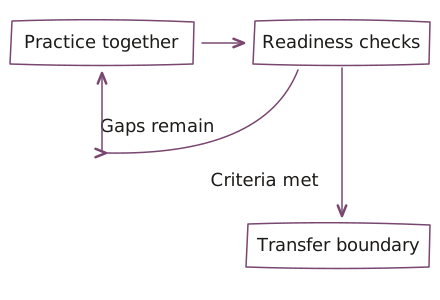
Ask the receiving operators to practice the responsibilities they will take on. Depending on scope, checks can include releasing a change, using rollback instructions, finding an architecture decision, running tests, or investigating a failed integration. Identify incident ownership and when specialist help is needed. Record gaps before responsibilities change; documentation alone does not establish readiness.
When another engagement fits better
Choose Fractional X when your team can deliver but needs an owner for agreed leadership decisions. A fractional CTO can address a technical leadership gap. Clarify that gap before adding implementation capacity; more engineers still need decisions about what to build and why. You can also compare a fractional CTO with an FDE.
Choose managed support when the main need is continuing care for an existing system. Define the operational responsibilities separately from a new implementation scope. Completing an FDE engagement does not silently create an ongoing support arrangement, and routine maintenance may not require an embed. If the boundary is unclear, compare what a warranty covers and what managed support adds.
Consider dedicated development teams when the need is continuing development capacity. Compare the responsibility for priorities, implementation management, and continuity with the other models. Any proposed team transfer needs a separate agreement and readiness checks; continuing capacity does not imply automatic ownership transfer.
Use Reverse FDE when operators need practice before taking agreed responsibilities. Reverse FDE is UCS’s name for preparing operators through shared delivery in UCS delivery systems. It can support a transition without a permanent embed, but transfer depends on demonstrated readiness and the agreed scope.
Revisit the model when the bottleneck changes. A build may reach the point where the remaining need is operational care, leadership, or sustained roadmap capacity. Review the receiving team’s responsibilities, unresolved gaps, and support needs before changing the arrangement. Keep Build, Scale, and Evolve connected through explicit decisions about who carries the work forward.
Bring one implementation problem
Bring the user workflow, current system boundaries, required access, and the first increment you need delivered. Include your product decision owner and the person who can approve access and accept the release. These details make it possible to discuss whether you need additional capacity under your plan or an agreed FDE implementation scope.
Use sanitized examples. Do not send credentials, confidential code dumps, or customer records. If access constraints are already known, describe the boundary without sharing the restricted material.
You can also email hello@ucs.tech with that implementation brief.
Questions before we start
Should we hire an FDE full-time or use FDE as a service?
A full-time FDE fits a continuing internal role you can recruit and manage. FDE as a service fits scoped delivery with partner support. Consider duration, management capacity, and the ownership your team needs to retain.
How long does an FDE embed last, and what does it cost?
FDE embed duration and fees depend on implementation scope, required skills, integration dependencies, access constraints, and handover needs. Agree on budget, milestones, and how scope changes affect cost and timing before work starts. There is no fixed price or duration without those details.
When should we avoid an FDE engagement?
An FDE engagement fits work that depends on close access to users, systems, and decisions. For leadership alone, routine maintenance, or tasks your team can deliver independently, consider another engagement.
How can an FDE engagement avoid a permanent services dependency?
An FDE engagement should keep decisions, tests, and runbooks with the product and review handover readiness at milestones. Your internal team can take agreed responsibilities, Reverse FDE can prepare operators, or managed support can provide separately agreed ongoing care.