
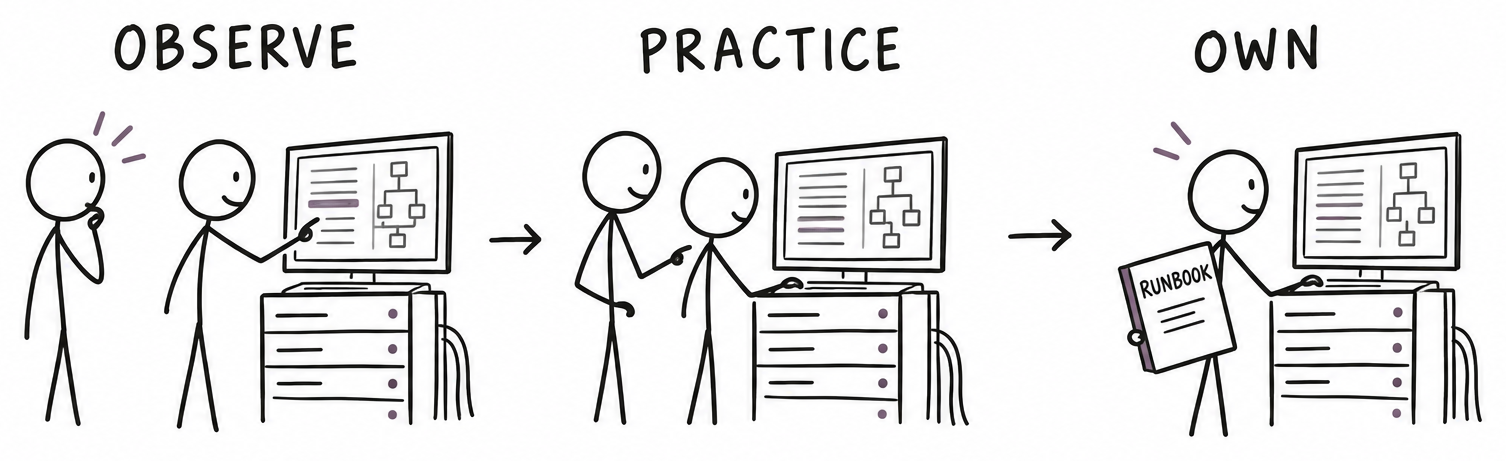
Your operators learn inside UCS delivery systems, share responsibility, and take ownership when readiness is demonstrated.
Prepare your operators to run and improve a working system, then transfer agreed responsibilities when readiness is demonstrated. Reverse FDE is UCS’s name for this shared delivery and knowledge-transfer engagement. Your operators practice inside UCS delivery systems so the work can scale without a permanent embed.
When delivery must become internal capability
The product works.
Now your people need to run releases, handle incidents, and improve it with confidence. A document handoff alone cannot build that judgment.
How Reverse FDE works
Customer operators join the delivery rhythm inside UCS: planning, reviews, release preparation, monitoring, and incident learning. We agree on access, responsibilities, and a practical ownership sequence before the work begins.
- Observe a working delivery cycle and understand its decisions.
- Share responsibility for releases and operational tasks.
- Demonstrate readiness against agreed acceptance criteria.
- Transfer ownership with a documented support boundary.
When knowledge transfer fits
Reverse FDE fits Scale → Evolve, after there is a working system and a repeatable way to deliver. For an initial build, start with Forward Deployed Engineers.
Sample readiness checks
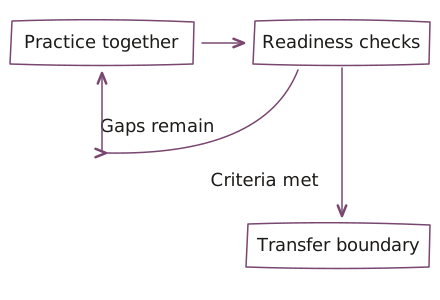
Use the working system to agree on observable checks. A receiving operator should be able to prepare a release, explain its acceptance and rollback steps, find monitoring information, and route an incident to the right person. The access owner should be able to identify permissions that must change at transfer. The receiving lead should know which specialist responsibilities remain outside the team.
For example, a transfer rehearsal could ask an operator to prepare a change in a permitted test environment while UCS observes. The operator explains how to check it, reverse it, and escalate a failed dependency. If the operator cannot complete a step, record the gap and repeat that part of the practice before transferring the responsibility. Choose rehearsal tasks and permitted environments around the responsibilities being transferred.
For AI systems, see what an AI system handover must include when choosing rehearsal tasks.
Reverse FDE needs available operators, a working delivery process, and permission to practice. If those prerequisites are missing, first stabilize delivery or use managed support for agreed operating coverage. Training alone may fit a discrete skill gap that does not involve transferring responsibility.
After the transfer
Keep managed support for agreed specialist coverage, retain fractional leadership, or discuss a broader dedicated team / BOT transition.
Questions before we start
Is Reverse FDE an established industry term?
Reverse FDE is UCS’s term for knowledge transfer through shared delivery. It prepares operators to take agreed responsibilities without a permanent engineering embed; it is not a standard industry category or a guarantee of transfer.
How does Reverse FDE differ from training?
Reverse FDE combines learning with practice in planning, reviews, releases, monitoring, and incident handling on a working system. Training alone may cover a skill gap; transfer requires operators to demonstrate agreed readiness with permitted access and time to practice.
How does Reverse FDE relate to build-operate-transfer?
Build-operate-transfer establishes, operates, and transfers a team. Reverse FDE prepares operators for responsibility and can support that transition, but does not itself transfer a team or establish a captive center. Contractual transfer terms remain separate.
When is a team ready to take ownership?
Reverse FDE readiness means operators can perform agreed release, incident, access, and documentation tasks. Use observable checks, record gaps, and name the person who accepts the transition. Unresolved responsibilities and specialist support need explicit owners before transfer.
What happens when operators are not ready?
A Reverse FDE transition should retain an agreed owner for responsibilities that receiving operators cannot yet carry. Review the gaps, narrow the transfer or extend practice by agreement, and separately scope any continuing support. A target date does not override readiness.
Bring the responsibilities you want to transfer
Bring the working system’s release process, a sanitized runbook outline, known operating gaps, and the proposed receiving roles. Include the person authorized to accept the transfer and the owner of any retained support. Do not send credentials, production incident dumps, or confidential repository exports in the initial inquiry.