
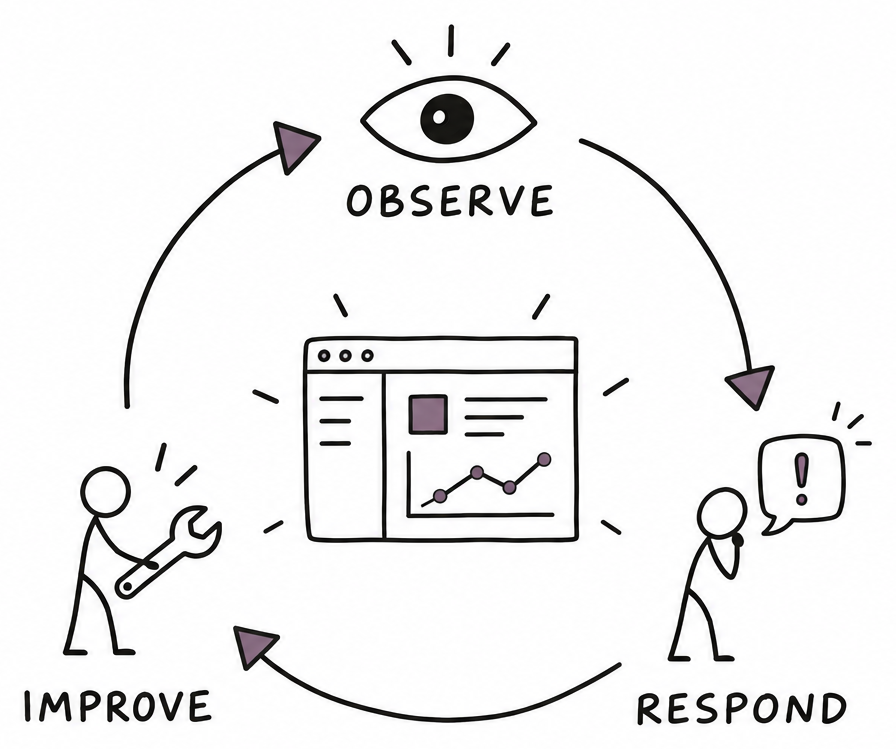
Observe the system, respond to what needs attention, improve it, and check the result. Coverage and escalation are agreed.
Managed product support is ongoing ownership of agreed software operations, maintenance, and improvements after launch. UCS provides it for teams whose customers and operations depend on a working system. Use it in Evolve when incident handling, release care, and operational continuity need defined responsibilities and an accountable service boundary.
Begin with a system health review
Review the application, infrastructure, known incidents, access arrangements, and operational risks.
Identify the systems that need coverage and the dependencies outside the team’s control. Use that assessment to prioritize monitoring, maintenance, and the first improvements.
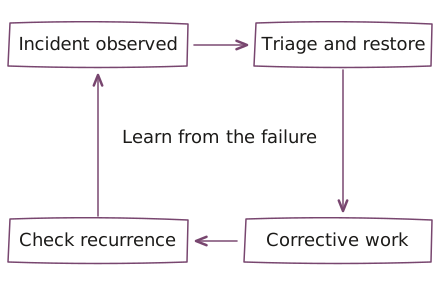
Turn incidents into preventive work
Agree on alerts, triage, and escalation before an incident occurs. Review recurring failures and move corrective work into a visible queue. Maintenance can include dependency updates, security fixes, and changes that remove repeated manual intervention.
Review performance and capacity
Track the behavior that affects users, including slow requests, errors, and infrastructure pressure. Review trends and plan capacity or configuration changes against the workload. Cloud, hybrid, and on-premises systems can be considered within the agreed service boundary.
How UCS engages: scope managed support operations
After the health review, agree on covered systems, coverage hours, incident priorities, response expectations, escalation contacts, and reporting. Scope monitoring and maintenance first, then review the improvement queue as the product evolves. Service levels and any out-of-hours coverage must be explicit in the agreement.
Managed support vs. warranty or new delivery
A project warranty covers defects under the original agreement. Managed support assigns continuing operational responsibilities. A substantial new feature or modernization program needs its own scope with FDE or product engineering, even when the support team contributes context. For the fuller boundary, compare managed support and a project warranty. For an AI system, see what AI operations add to managed support.
Build internal ownership over time
Keep runbooks, change records, and unresolved risks available to your team. Use Reverse FDE for operator readiness during Scale → Evolve, or Fractional X for longer-term technical direction.
Bring the system and its support boundary
Bring a system map, current runbook outline, sanitized incident patterns, and required coverage hours. Include the service decision owner and the person who can approve access and escalation rules. Do not send credentials, confidential logs, or production data dumps.
Questions before we start
How is managed support different from a project warranty?
A warranty covers defects under the original project agreement. Managed support is a separate, ongoing service covering agreed operations, maintenance, and improvements.
What does UCS own, and is there an SLA?
Each engagement defines covered systems, monitoring, escalation, coverage hours, and service levels. Round-the-clock coverage and response times apply only if agreed; neither is a default promise.
When does Evolve need managed support?
Managed support fits live systems that need ongoing care beyond what your internal team can or should own. Review responsibilities as your team’s capability grows.
Can UCS support an existing product built by another team?
UCS can assess an existing product for support through a health and risk review. Documentation, access, dependencies, incident history, and any required remediation inform the coverage agreement. The same review applies if the product was built mostly with AI coding tools.
Are new features included in managed support?
Only improvements within the agreed support scope are included. Substantial features, migrations, and architecture changes need separate priorities, acceptance criteria, and delivery scope. Review support and roadmap work together to keep ownership clear.
What should a support agreement for a live AI system cover?
A support agreement for a live AI system should name what is in scope, such as rerunning evaluations, changing prompts and moving to a new model, and what is handled as separate work. It should say who approves each change before it reaches users, usually a named owner on your side after the evaluations pass. It should also list what you keep if you switch provider, including prompts, evaluation sets, logs, configuration and access to every account the system runs on.